Fugitive on Four Legs: What Your Escape-Artist Pet Is Really Trying to Tell You
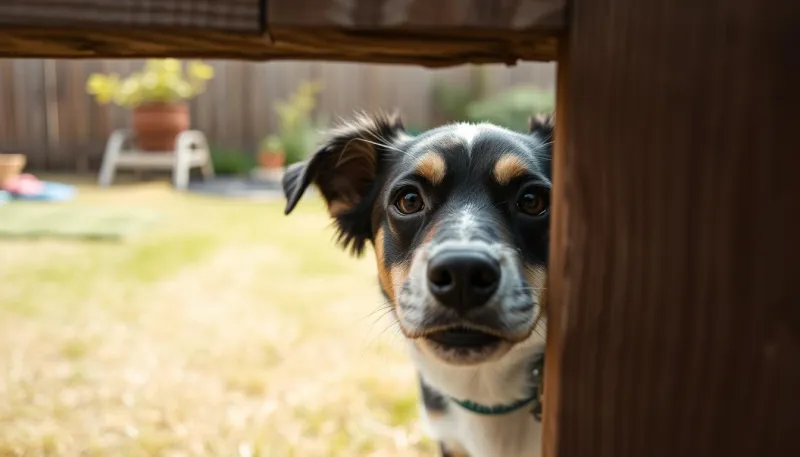
Photo: dog escaping through fence in backyard, via bestdogfencing.com
You've triple-checked the latch. You've filled in the hole under the fence — twice. You've even considered installing one of those revolving doors that only spins inward. And yet, there goes Biscuit again, a golden blur disappearing into the neighbor's hydrangeas like he's auditioning for a heist film.
If your pet has a recurring hobby of attempting The Great Escape, you're not alone — and you're probably not a bad pet parent. What you are is living with an animal whose brain is sending a very loud, very insistent signal. The question is whether you're fluent in the language.
Let's decode it.
The Bolt at the Door: Speed, Instinct, and the Smell of Everything
Door-darting is one of the most common — and most panic-inducing — escape behaviors in dogs especially. Your pup sees a sliver of open space and launches through it with the focused energy of an Olympic sprinter. It feels personal. It isn't.
For dogs, the world beyond your front door is basically a sensory buffet. Every squirrel, fire hydrant, and passing jogger represents a data point their brains are wired to investigate. Veterinary behaviorists describe this as exploratory drive — a deeply instinctual need to patrol, sniff, and assess territory. Some breeds, particularly hounds, huskies, and terriers, have this drive cranked up to eleven by centuries of selective breeding.
The fix here isn't just about better door management (though teaching a solid "wait" command is genuinely life-changing). It's about asking: is your dog getting enough mental and physical stimulation inside the fence? A tired dog with a satisfied nose is a dog who doesn't need to go looking for adventure elsewhere.
The Fence Digger: When Anxiety Wears a Muddy Paw
If your yard looks like it was landscaped by a determined badger, your pet might be dealing with something deeper than wanderlust. Fence-digging and barrier-frustration behaviors are frequently linked to separation anxiety, boredom, or — particularly in intact male dogs — the magnetic pull of a nearby female in heat.
Here's the uncomfortable truth that veterinary behaviorists want more families to hear: escape behavior is often a symptom, not the problem itself. A dog who digs frantically every time you leave for work isn't being defiant. They're panicking. The fence isn't the obstacle — your absence is.
For families navigating this, the approach needs to address the emotional root. That might mean gradual desensitization training, puzzle feeders that keep a pet's brain occupied during alone time, or — in more serious cases — a conversation with your vet about whether anxiety support is appropriate. Patching the fence without addressing the anxiety is a bit like putting a bandage on a broken arm. Functional, briefly. Not a solution.
Cats Are a Whole Different Jailbreak
Let's talk about the feline contingent, because their escape motivations deserve their own paragraph of respect. Indoor cats who persistently try to slip outside are often driven by one of three things: reproductive urge (spaying and neutering dramatically reduces this), predatory instinct triggered by birds or squirrels visible from a window, or genuine boredom from an under-stimulating environment.
Cats are not low-maintenance creatures who are fine staring at a wall. They are small, clever predators with complex needs. An indoor cat who watches a bird feeder for three hours a day and has no outlet for that energy will find one — usually through your screen door.
Enriching your indoor cat's environment with climbing structures, rotating toys, and dedicated interactive play sessions can significantly reduce the urge to bolt. Some families have had remarkable success with "catio" enclosures — screened outdoor spaces that let cats experience the outside world without the associated risks. It's the pet equivalent of a screened-in porch, and honestly, some of them look nicer than the human furniture.
What Escape Behavior Is NOT (Spoiler: It's Not Spite)
This bears repeating because the guilt and frustration of having a persistent escape artist can make it feel like a personal slight. Your pet is not trying to leave you. Animals don't plot revenge. They don't harbor resentment about the time you accidentally stepped on their tail in 2019.
What they do have is a nervous system responding to stimuli, and a set of needs that — when unmet — generate behaviors that look, to us, like rejection. Understanding this reframe doesn't just help you solve the problem more effectively. It also takes a lot of the sting out of the chase.
Practical Strategies That Actually Work
Before you go full Fort Knox on your backyard, here's a prioritized approach that combines behavioral science with real-life family logistics:
1. Rule out medical and reproductive causes first. An unneutered or unspayed pet has a biological imperative that no amount of training will fully override. This is the single most impactful intervention for many escape-prone pets.
2. Audit stimulation levels honestly. How much exercise is your dog actually getting? How many interactive play sessions does your cat have each week? "They have toys" is not the same as enrichment. Engagement matters.
3. Invest in management while you train. Baby gates, airlock-style entryways, and L-shaped fence extensions at the bottom (for diggers) buy you time while you work on the behavioral piece. Management and training aren't mutually exclusive.
4. Consult a professional if the behavior is severe. A certified applied animal behaviorist or veterinary behaviorist is worth every penny when anxiety is clearly driving the escape attempts. This isn't a failure — it's smart resource deployment.
5. Make home worth staying in. This sounds obvious, but it's the most overlooked piece. A yard with a digging pit, a rotating selection of enrichment toys, and regular family interaction creates a pet who genuinely prefers being home. Imagine that.
The Bottom Line
Your Houdini-in-fur is not broken, and neither are you. They're communicating in the only language they have — behavior — and they're being remarkably consistent about it. The families who crack the code aren't the ones with the tallest fences. They're the ones who got curious about what was driving their pet to the edge of the yard in the first place.
Listen to the behavior. Then build a home so good, they stop looking for the exit.