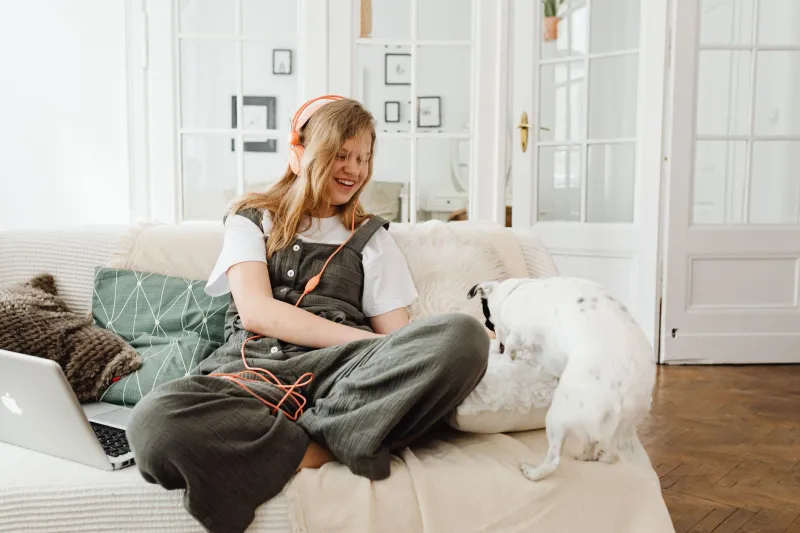
Your Pet Is Basically Your Personal Trainer (And Therapist, and Cardiologist)

Somewhere right now, a dog owner is being dragged around the block at 6:45 AM, coffee-free, in pajama pants that are technically not appropriate for public, muttering mild complaints at a labrador who is absolutely thriving.
And that dog owner's heart is healthier for it.
Welcome to the most underrated wellness program in America: pet ownership. It doesn't require a gym membership, a motivational podcast, or a $200 pair of leggings. It just requires an animal who refuses to let you stay on the couch.
The research on this topic has been quietly piling up for decades, and the findings are, frankly, impressive. Your pet is doing things to your body and brain that would cost a fortune to replicate through conventional health interventions. Here's a look at the science—and a few honest stories from families who didn't realize they were getting a wellness transformation along with the fur.
The Heart Stuff: Your Pet Is Literally Keeping You Alive
Let's start with the big one. The American Heart Association has formally recognized a link between pet ownership—particularly dog ownership—and reduced cardiovascular disease risk. A 2019 study published in Circulation, the AHA's flagship journal, analyzed data from more than 3.8 million people and found that dog owners had a 24% lower risk of dying from any cause, and a 31% lower risk of dying from cardiovascular disease, compared to non-dog owners.
Thirty-one percent. That's not a rounding error. That's a statistically significant, peer-reviewed, multi-million-person finding that your dog might be the best cardiological intervention you've ever stumbled into.
The mechanisms are multiple:
Increased physical activity. Dog owners walk more. A lot more. Studies consistently show that dog owners meet physical activity guidelines at higher rates than non-owners, primarily because dogs are non-negotiable about their walks in a way that a gym membership simply is not.
Lower resting blood pressure. The act of petting an animal has been shown to reduce blood pressure in both the person and the pet. It's a mutual chill-out session with measurable physiological effects.
Reduced triglyceride and cholesterol levels. Multiple studies have found that pet owners tend to have more favorable lipid profiles than non-owners, even after controlling for diet and exercise. Researchers aren't entirely sure why, but the data keeps showing up.
The Cortisol Situation: Stress Doesn't Stand a Chance
Cortisol is your body's primary stress hormone. In short bursts, it's useful. Chronically elevated, it contributes to everything from weight gain to immune suppression to anxiety disorders.
Pet ownership is a cortisol demolition crew.
A landmark study from the State University of New York at Buffalo found that people performing stressful tasks had lower cortisol spikes when their pet was present than when a friend or spouse was in the room. (No offense to spouses everywhere, but the data is the data.)
The interaction between humans and pets also triggers the release of oxytocin—the so-called "bonding hormone" associated with trust, connection, and emotional wellbeing. Just looking at your dog can initiate this response. A 2015 study in Science found that mutual gazing between dogs and their owners increased oxytocin levels in both species. Both. Your dog gets a biochemical hit of love when you look at them, and so do you.
This is either the most wholesome thing you've ever read or the most effective argument for pet ownership in recorded history. Possibly both.
The Mental Health Angle: More Than Just Good Vibes
The psychological benefits of pet ownership are well-documented and span a surprisingly wide range of conditions.
Studies have shown that pet owners report lower rates of depression and loneliness. Older adults with pets demonstrate better cognitive function over time. Veterans with PTSD who participate in animal-assisted therapy show significant reductions in symptom severity. Children who grow up with pets demonstrate higher empathy scores and better emotional regulation.
Dr. Sandra Barker, director of the Center for Human-Animal Interaction at Virginia Commonwealth University, has spent years studying these effects. Her research consistently shows that even brief interactions with animals reduce anxiety and improve mood in measurable ways.
For families, the mental health effects are layered. Parents report that watching their children interact with pets provides its own emotional lift—a kind of secondhand joy that's hard to manufacture any other way.
"There's something about watching my kid with our dog that just resets my whole day," says Kevin, a father of two from Nashville whose rescue mutt, Pretzel, arrived during the pandemic. "I can be completely fried from work, and then I see those two rolling around in the backyard, and I just... feel better. Like immediately."
The Workout You Didn't Know You Were Getting
Here's a fun reframe: every morning walk your dog forces you to take is a cardiovascular exercise session. Every game of fetch is interval training. Every time you lug a 40-pound bag of food from the car to the pantry, that's functional strength work.
A study published in the Journal of Physical Activity and Health found that dog owners were 54% more likely to meet recommended physical activity levels than non-dog owners. Another study from Michigan State University found that dog walkers were 34% more likely to complete 150 minutes of walking per week—the minimum recommended by the CDC for adult health.
And it's not just about the walks. Cat owners who engage in active play sessions, rabbit owners who chase escaped bunnies around the living room (a truly elite cardio experience), bird owners who perform the daily acrobatics required to clean and manage a large cage—all of it adds up.
Carrie, a 47-year-old from Phoenix, didn't own a pet for the first four decades of her life. Then she adopted a high-energy Australian shepherd mix named Rocket.
"I lost 22 pounds in the first year," she says, sounding mildly incredulous about it. "I wasn't trying to lose weight. I was just trying to keep up with the dog. He basically drafted me into a fitness program I never would have signed up for voluntarily."
The Immune System Bonus Round
Here's one for the parents: children who grow up in homes with pets have been shown to have stronger immune systems and lower rates of allergies and asthma. Exposure to pet dander and the microorganisms animals bring into the home appears to train the developing immune system in beneficial ways.
A study published in JAMA Pediatrics found that children exposed to dogs in the first year of life had significantly lower rates of respiratory infections and ear infections. The hygiene hypothesis—the idea that some early exposure to environmental microbes actually strengthens immunity—gets a significant boost from the pet-ownership data.
So the next time someone in your household complains about dog hair on the couch, you can explain that it's essentially a delivery system for immune education. You're welcome.
The Glow-Up Is Real
Nobody gets a pet for the health benefits. You get a pet because you fell in love with a face, or because your kid wore you down over approximately 18 months of lobbying, or because a rescue animal needed a home and you happened to be standing there.
But the benefits show up anyway. They accumulate quietly, walk by walk, cuddle by cuddle, cortisol-lowering gaze by cortisol-lowering gaze.
Your pet is not trying to improve your cardiovascular health. They're trying to get breakfast. But in the process of getting you out the door, onto the floor, and occasionally across the yard at a dead sprint, they're doing something remarkable.
They're making you healthier. And they're doing it for free, with zero judgment about your pajama pants.
That, genuinely, is the best deal going.