Baby's Coming—But Your Pet Heard It First: The Science of Pre-Baby Prep for Your Furry Family Member
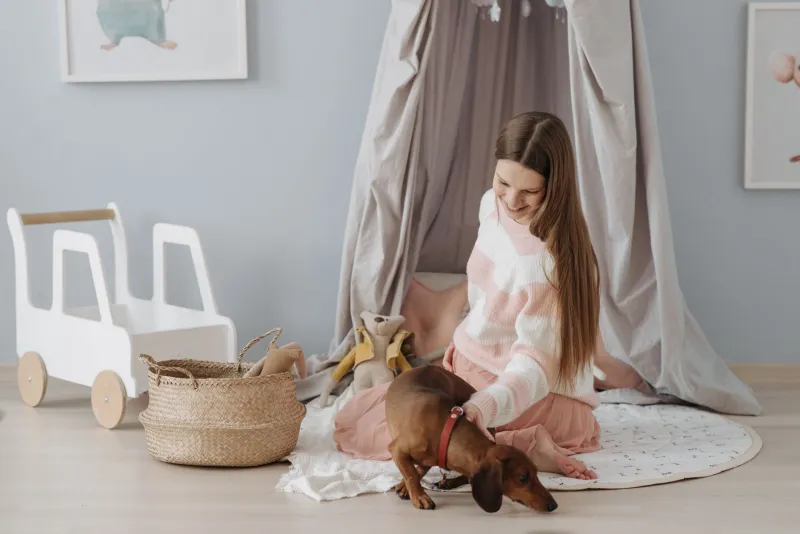
Your dog has already figured it out.
You haven't said anything. The nursery furniture is still in boxes. But your golden retriever is following you from room to room with an expression that can only be described as professionally concerned. Animals pick up on hormonal shifts, behavioral changes, and environmental cues long before we announce anything on Instagram. They know something is happening.
The question is: what are you going to do about it before the baby actually arrives?
Most advice on this topic focuses on what to do after you bring the baby home. But behavioral science and animal cognition research increasingly point to the months before delivery as the most critical window for preparation. Early, intentional intervention doesn't just make the transition smoother—it can fundamentally reshape how your pet experiences the new family dynamic.
Here's what the science says, and what you can actually do about it.
Why Your Pet's Nose Knows Everything
Let's start with scent, because your pet's relationship with smell is basically a superpower you haven't fully leveraged yet.
Dogs have up to 300 million olfactory receptors in their noses, compared to about six million in humans. Cats aren't far behind. This means that before your baby ever enters your home, your pet can—and should—be introduced to that baby's scent in a controlled, positive way.
This technique, sometimes called scent swapping or scent introduction, is backed by animal behaviorists and recommended by organizations like the American Kennel Club and various certified animal behavior consultants. The protocol is simple:
- After the baby is born but before you bring them home, have your partner or a family member bring home an item the baby has worn or been wrapped in—a onesie, a swaddle blanket, a hat.
- Let your pet sniff the item calmly, without forcing interaction.
- Pair the sniffing experience with something positive—a treat, calm praise, or a favorite game.
- Repeat over several days before the baby arrives home.
What you're doing is teaching your pet's brain to associate the baby's scent with good things before the baby becomes a physical, crying, unpredictable presence in the house. That's a significant head start.
The Months-Out Timeline: What to Do and When
The earlier you start, the better your outcomes. Here's a practical timeline that behavioral experts generally support:
Six or More Months Before Baby Arrives
Audit your pet's training. If your dog jumps on guests, pulls on the leash, or resource-guards food and toys, now is the time to address those behaviors—not when you're sleep-deprived with a newborn in your arms. Work with a certified professional dog trainer (look for CPDT-KA credentials) to shore up any gaps.
Begin desensitizing to baby sounds. Play recordings of infant crying, cooing, and babbling at low volumes while your pet is relaxed. Gradually increase the volume over weeks. This prevents the first real cry from triggering a full panic response.
Introduce baby-related smells. Start using baby lotion, baby powder, or baby shampoo on your own skin occasionally. Your pet will begin associating those scents with you—a trusted, safe figure—well before they're associated with a tiny stranger.
Three Months Before
Reconfigure your space. Set up the nursery and let your pet explore it under supervision. Establish any off-limit boundaries now, using baby gates or positive reinforcement, so your pet isn't suddenly locked out of a room they've always had access to. That kind of abrupt change, timed to the baby's arrival, can create negative associations.
**Practice "baby simulation." ** Carry a weighted doll around the house. Walk with it. Sit with it on the couch. Weird? Yes. Effective? Also yes. You're teaching your pet that this new behavior from you—carrying something carefully, bending differently, moving more slowly—is normal and unthreatening.
Adjust your pet's schedule proactively. If your dog currently gets walked at 7 AM by you, and that's going to change postpartum, start shifting that routine now. Abrupt schedule changes timed to the baby's arrival can cause anxiety and behavioral regression.
One Month Before
Bring in the scent. As described above, start introducing items that carry newborn scent from the hospital as soon as they're available.
Practice controlled introductions. Have friends or family members bring small babies or toddlers to your home for brief, supervised visits. Observe your pet's reaction carefully. Are they curious and calm, or overstimulated and anxious? This tells you where you need to focus your final preparation energy.
The Cortisol Connection: Why Stress Is Contagious
Here's a piece of research that might surprise you: pets absorb their owners' stress. A 2019 study published in Scientific Reports found that dogs' cortisol levels mirror their owners' cortisol levels over time, suggesting a genuine stress-sharing dynamic between humans and their pets.
What this means practically: if you're anxious about the baby's arrival, your pet is anxious too—and they don't have the benefit of understanding why. Managing your own stress during the prenatal period isn't just good for you; it's a form of pet care.
Practices like maintaining regular exercise routines with your pet, keeping interaction time consistent, and projecting calm during preparation activities all serve double duty: they support your wellbeing and regulate your pet's emotional state.
What the First Meeting Should Actually Look Like
When you finally bring your baby home, resist the instinct to make it a grand introduction moment. The most behaviorally sound approach is actually pretty anticlimactic—which is exactly the point.
- Have the non-baby-carrying parent greet the pet first, calmly, to absorb the initial excitement.
- Let your pet approach and sniff at their own pace. Don't force proximity.
- Keep the first interactions short and positive.
- Never leave pets and infants unsupervised, regardless of how well-prepared your pet is.
The goal isn't a heartwarming viral moment on day one. The goal is a calm, sustainable relationship that deepens over months and years.
The Long Game
Jessica and Marcus from Portland started their prep five months before their daughter arrived. Their two cats, Biscuit and Theorem, had never been around babies. They did the scent work. They played the recordings. They set up the nursery early.
"The day we brought Lily home, Biscuit walked over, sniffed her carrier, and just... went and lay down," Jessica says. "Like it was completely normal. Which I guess it was, for him, at that point."
Theorem took a few more weeks. But by month two, he was sleeping near the nursery door every night.
That's the goal. Not perfection on day one—but a foundation solid enough that your pet and your child can build something real together. And that foundation starts right now, months before the first cry echoes through your house.
Your dog already knows something's coming. Give them the tools to be ready for it.